Hope in the Ashes: A New Historical Adventure for Kids
One of my favorite ways to introduce kids to history is through a really good story.
There is something about following a character through a historical event that makes history feel much more alive than simply reading a paragraph about it in a textbook. Suddenly, a date has a story. A place has people. And an event that happened more than a hundred years ago feels a little more real.
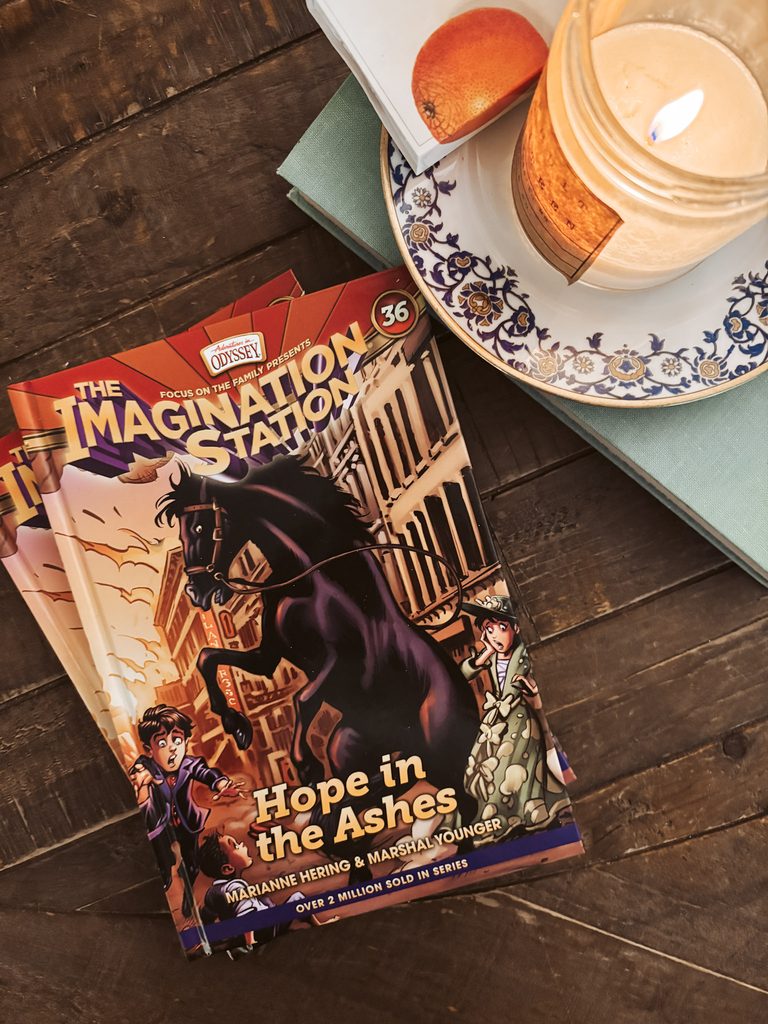
That’s why I was excited to take a look at Hope in the Ashes, the newest book in the Imagination Station series from Focus on the Family.
Learning Well LLC is a participant in the Amazon Services LLC Associates Program. As an Amazon Associate, I earn from qualifying purchases. Affiliate links from Amazon or other programs are used on this website. For more info, please refer to our disclosure statement.
Hope in the Ashes is book #36 in the series and takes readers on a time-travel adventure to Chicago in 1871, right in the middle of the Great Chicago Fire.
Disclosure: This post was sponsored by Tyndale. I received compensation for my time. As always, all opinions expressed here are my own.
What Is Hope in the Ashes About?
If you’re familiar with the Imagination Station books, you already know the basic premise: cousins Patrick and Beth step into the Imagination Station and find themselves transported to another time and place.
In Hope in the Ashes, they travel to Chicago in 1871 just as flames begin to consume the city.
The Great Chicago Fire was one of the most devastating disasters in American history, and the book puts Patrick and Beth right in the middle of the action. As the fire spreads, the cousins race to help people who are in danger—and along the way, they encounter the well-known evangelist Dwight L. Moody.
That combination of history + adventure + faith is what makes this such an appealing read for Christian homeschool families.
A Fun Way to Experience American History
One of the things I appreciate about historical fiction for kids is that it can give them a framework for understanding events before they ever encounter them in a traditional history book.
Instead of simply saying, “The Great Chicago Fire happened in 1871,” a story allows a child to imagine what it might have been like to be there.
What would you do if a fire were spreading through your city?
Where would you go?
Who would you help?
What would it be like to watch your home or neighborhood disappear?
Those kinds of questions can turn a historical event into something a child actually wants to learn more about.
And that gives us as homeschool parents a natural opportunity to say, “Okay, now let’s learn what really happened.”
After reading the book, you could easily pull out a map of Chicago, look at photographs of the city before and after the fire, read about the causes and aftermath of the disaster, or learn more about Dwight L. Moody.
The story becomes the doorway into a much larger history lesson.
Faith Is Woven Into the Story
Another reason Hope in the Ashes caught my attention is that faith isn’t simply tacked onto the story.
The Imagination Station series is designed around biblical values, and the official description specifically highlights the theme of trusting God when things are difficult.
And really, the Great Chicago Fire provides a natural setting for those kinds of questions.
What does it mean to trust God when circumstances are frightening?
How do we respond when we see other people in need?
How can we help when we can’t fix everything?
Those are meaningful conversations to have with our kids, and historical fiction gives us a natural starting point for them.
Great for History-Loving Kids
Hope in the Ashes is written for children around ages 7–10 and is a 160-page hardcover.
That makes it a great option for elementary-age readers who enjoy action and adventure but are also ready for more substantial chapter books.
And if your kids already love the Imagination Station series, this is an obvious addition to the bookshelf.
The series has sold more than 2 million copies, and Hope in the Ashes is the 36th installment.
LEARN MORE ABOUT THE IMAGINATION STATION SERIES
How We Could Use This in Our Homeschool
This is the kind of book I would be tempted to use as a history supplement rather than assigning it as “school.”
Read a chapter together.
Talk about what is happening.
Look something up.
Maybe find Chicago on a map.
Then put the book down and come back to it the next day.
You could also use it as an independent reading book for a child who loves historical fiction.
And if you’re studying American history, the Great Chicago Fire would make a natural mini-unit:
- Read Hope in the Ashes
- Study the Great Chicago Fire
- Find Chicago on a map
- Learn about life in 1871
- Research how cities responded to the fire
- Learn more about Dwight L. Moody
- Discuss how Christians responded to the disaster
- Compare Chicago before and after the fire
That’s one of my favorite things about a good historical novel: the learning doesn’t stop when the book ends.
A New Book to Add to the Reading List
If you’re looking for engaging Christian historical fiction for an elementary-age reader, I’d definitely put Hope in the Ashes on your list.
It combines a dramatic moment in American history with the time-travel adventure kids already love from the Imagination Station series, while giving families opportunities to talk about faith, courage, service, and trusting God when life gets difficult.
And honestly, isn’t that one of the best things about homeschooling?
A history lesson can start with a book on the couch, turn into a conversation at the kitchen table, and suddenly your child is asking questions you never would have thought to put on a worksheet.
That’s the kind of history I want more of in our homeschool.