Homeschooling Day in the Life: Erin, homeschooling mom to four, from middle school up to graduate
A homeschool day in the life looks different almost every day, right? Over on our Instagram page, we love to give you a peek into lots of homeschool days regardless of how they change day to day.
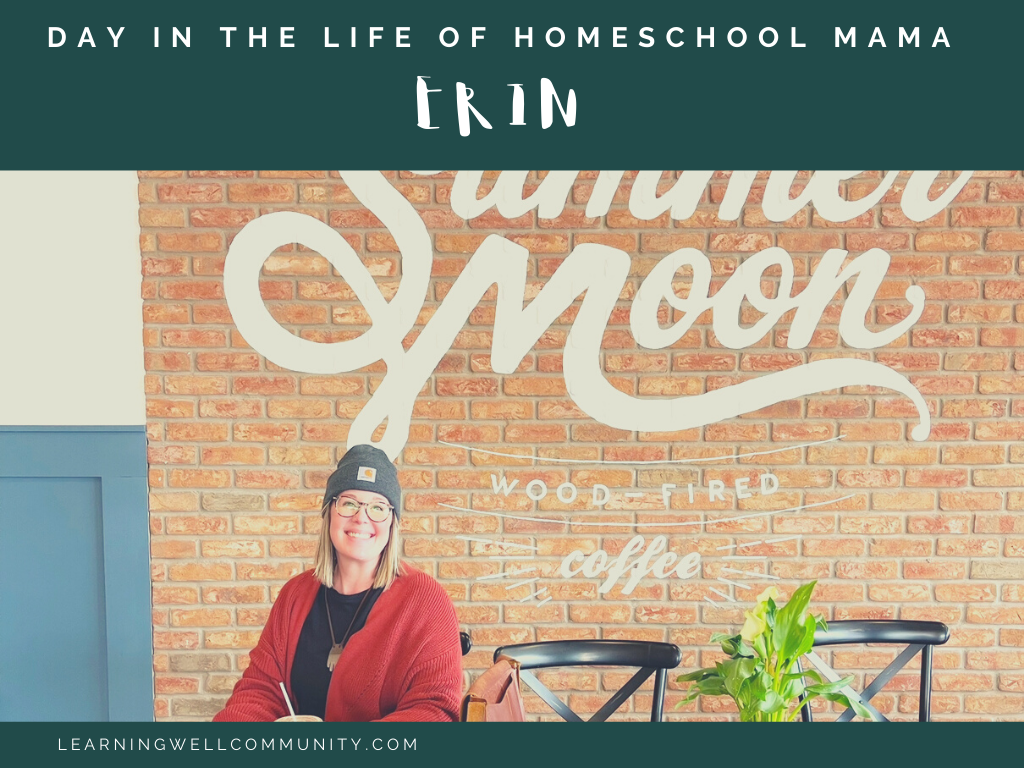
Today, we’re going to give you a peek into the homeschool day in the life of Erin, homeschooling mom to four children, from middle school up to graduate.
We can all learn and be inspired by one another, regardless of our homeschool approach. It’s not about looking good for social media, it’s about the connection going on inside our homeschool walls and sharing with others what works for us.
Learning Well LLC is a participant in the Amazon Services LLC Associates Program. As an Amazon Associate, I earn from qualifying purchases. Affiliate links from Amazon or other programs are used on this website. For more info, please refer to our disclosure statement.
We might all homeschool a little differently, but we can always look for ideas from each other that inspire, encourage and equip us in our own homeschool days. So each week we create blog posts for you to access later of each of those “days in the life”. We hope you keep coming back for more inspiration. Keep going, mama! These days at home are so worth it!
Meet Erin

Erin Hisaw @erin.host.hisaw is 45 {but frequently forgets and tells people she’s 43🤷🏼♀️}. She is a Bible-believing wife and homeschooling mom of four {well, mom of four, homeschooling three — one graduate; a son that’s a high-school junior; an eighth-grade daughter; and a sixth-grade daughter}.
Erin taught in traditional private schools for five years before having children and applies her background in education to their daily homeschool practice.
Erin’s favorite music is silence. Her favorite hobby is reading. Her favorite places are home and random coffee shops, and her favorite people are her husband, kiddos, and in-laws {yes, in-laws}.
Good Morning!
Good morning! I’m Erin @erin.host.hisaw, and I’ll be sharing our day with you.
I’m excited! It kind of feels like throwing it back to the good old blogging days.
My weekdays usually start around 5am, even though I’m not naturally an early riser. I manage social media accounts for a handful of small local businesses; and I’ve found, over the five years I’ve been doing so, that if I don’t get my “job work” done before our school day begins, time runs away from me, and I’m left panicking at 4:00 in the afternoon.
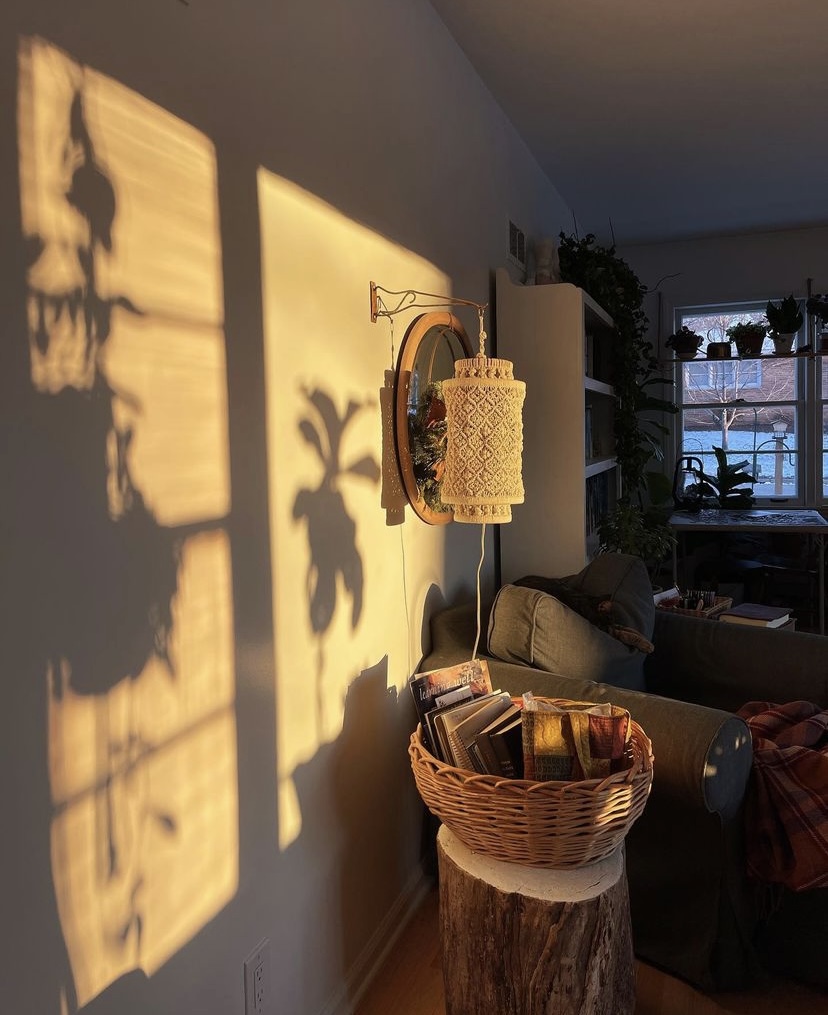
I typically rise at 5am; make my smoothie and take my vitamins; then settle into my favorite chair {in the dark part of this pic} and work until i wake the girls at 7:30am for read-aloud time.
Where We Do School
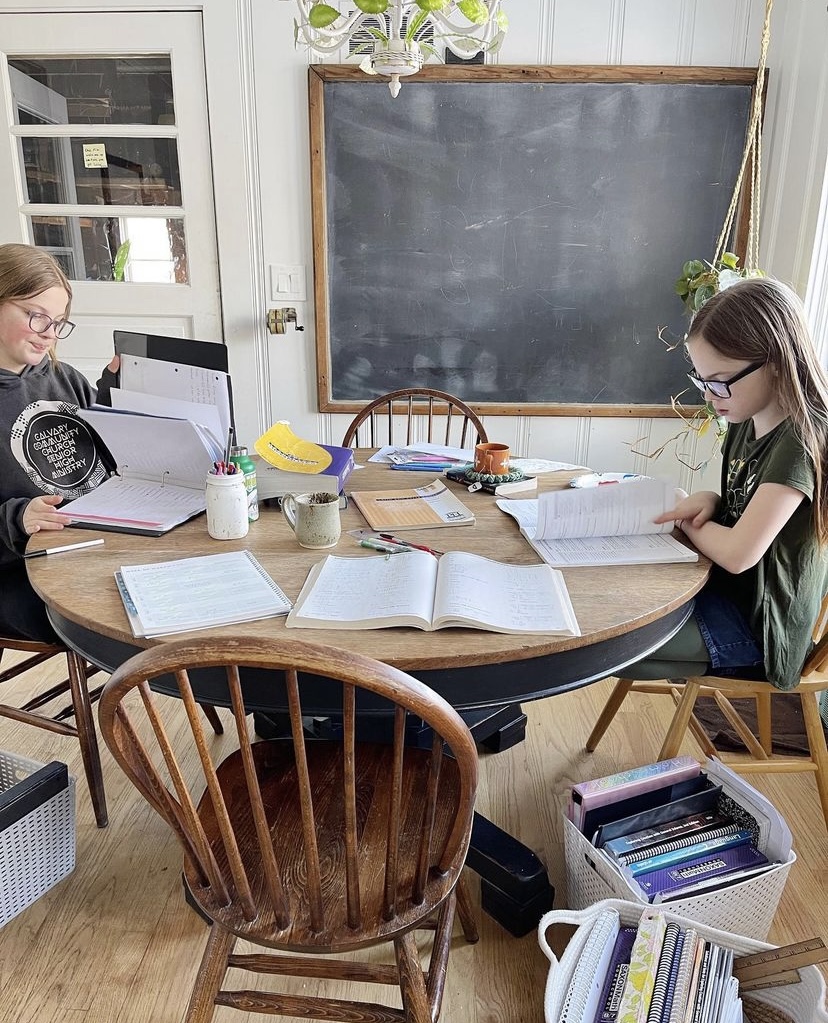
This is where we do school–at our dining room table {although to call this tiny space a “dining room” is a bit laughable}. This is where we’ve always done school — even in other houses — always at our table.
I think maybe once years ago I tried to set up a “school room” somewhere else in our house {different house than this one} and gave up on it after just a few days. A separate school space just doesn’t work for us. We always gravitate back to this spot. A great majority of my daily housework is done in the kitchen, so it just makes sense to have the kiddos and their schoolwork nearby, right at hand.
I’m wiping counters while they’re writing spelling words {recorded in voice memos on my phone}, loading the dishwasher while they’re studying vocab, or sautéing onions while they finish a language exercise. This is just what works for us.
Some gorgeous homeschool accounts have incredible learning spaces — and that’s truly awesome. However I also want you to know that your kiddos can have a fabulous learning experience right at your kitchen table with no fancy alphabet borders, or table of the elements charts, or anatomy diagram posters.
Individual Work vs. Together Time

The girls usually disperse from the table to do their individual work wherever they’d like once our “together time” at the table is finished. Addison usually chooses this chair in the living room.
Eden often stays at the table.
I’m currently schooling both girls — 8th grade age and 6th grade age — 100% together at an 8th grade level. Eden, our 6th grader has been handling it fine all year, so I anticipate keeping to that as long as she keeps tracking with it. Don’t jump ahead and ask me what I’m going to do when she’s ready to dual enroll at 14 — I’m not there yet.🤣
Our “together time” — meaning the time I am at the table 100% plugged in with them — is usually finished up by noon each day. Today we finished early at 11am.
Next year, with both girls in freshman level subjects and actual high school work, will look different. Our “together time” will take considerably longer each day. So for this year, I’m savoring my lighter days, knowing next year’s school days will be longer, and that’ll be okay.
Our Approach to Homeschooling

I might be a little bit of an oddball in this homeschool community because we tend to take a very traditional approach to our homeschooling. We wake up at the same time every day, start school at the same time, do the same subjects, have assignments, finish the books each school year, etc.
My background is in education, and as much as different approaches to school interest me, this is just how my brain works. I’m not saying this is how anyone else’s brain should work, just that that’s how my brain does work.
At the end of each day, I write all of the outstanding assignments in their individual work on the board. Wednesday’s board is especially full during this season because we are participating in a homeschool co-op on Thursdays and Fridays, which are our “all individual work” days. Therefore, Wednesday’s board encompasses Wednesday’s remaining work, and the work for the rest of the week.
I don’t divvy the work up into daily chunks for the girls. They have to figure out how to get all of what’s on the board done by the time we start school on Monday. This has actually proven to be an excellent strategy for teaching them time management, planning, etc.
My Free Time

I’m a big reader, so it only makes sense that one of my posts would be about books, right? I walk and talk with God all day every day, but our set-aside time together is in the afternoons since my early mornings are spent doing my “job work.” Some days our time is fifteen minutes, some days it’s hours, but the point is, that time is there.
Books I’m currently working through :
• the Bible. obviously. of course. always.
• Always in God’s Hands {daily devotional}
• New Morning Mercies {also daily devotional}
• the little white notebook in between these two is where I take notes from my daily devotions and the scripture readings.
• personal {and small group} study through the book of James. The orange book and thin blue book go with that; spiral bound notebook is for those notes.
small group is beginning new study on I & II Timothy and Titus in two weeks, and I’m excited about that.
• Knowing God {study with different small group}
Bible and two devotion books are every day — others are read / studied as time allows between group meetings.
I am a voracious fiction reader, finishing 50-100 books each year. Reading is where I find rest, so I watch very little television. I highly prefer fiction because i don’t want to feel like I should be learning / retaining anything.
I’m currently reading my second book by Kelly Rimmer, The Warsaw Orphan. You can see my review on the other book I read by her on my personal feed. I also have two book highlights over there — “2022 books” for books from this year and “books” for older book reviews.
Our Curriculum
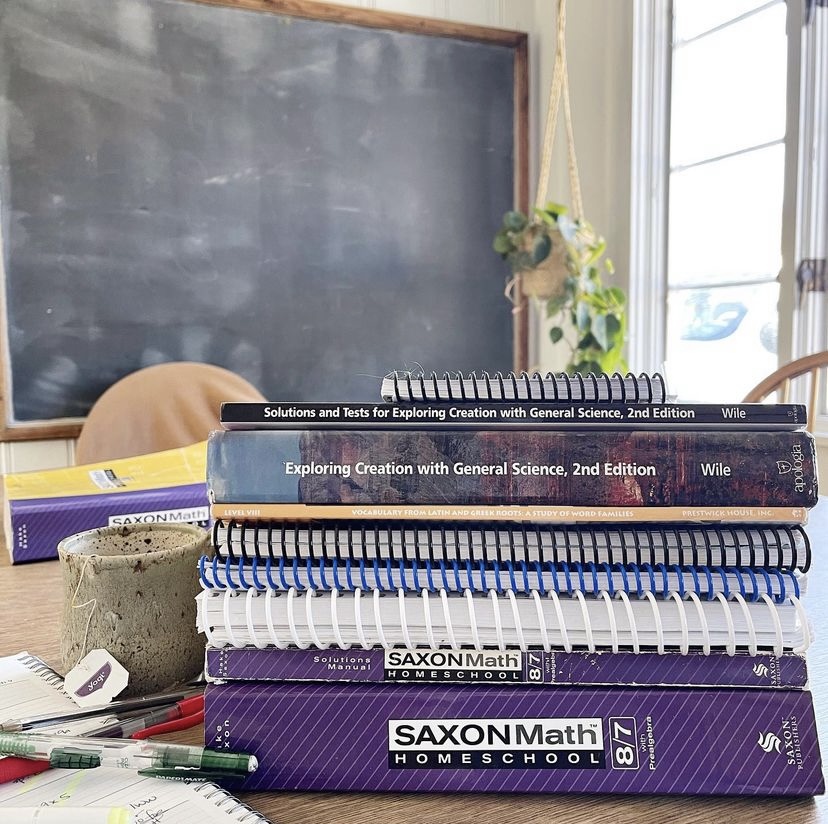
Your eyes aren’t playing tricks on you — it’s another book post.
I have had lots of requests asking what we use for different subjects / grades. I will attempt to cover that here.
• Math — Saxon forever and always. I realize this is very polarizing. A lot of people do not like Saxon math, but I love it. I believe it’s an excellent math curriculum. We use Saxon math through 10th grade, which is algebra II {that’s my “ceiling” of capability of math teaching}. Colton is dual-enrolling for his upper level math. Austyn {graduated} had no plans for college and hated upper math, so we chose Dave Ramsey’s high school curriculum for her 3rd math credit. It was fabulous!
note : we use pre-common core Saxon editions.
• Language — Abeka forever and always. A lot of people view grammar rules and punctuation and diagramming and knowing phrases from clauses so passé, but I don’t. Abeka has worked incredibly well for us and is a very strong language curriculum. Passing 10th grade Abeka language is considered to put you at college level. Our oldest daughter beat the language section of the smart test at our community college when she was dual-enrolling. I’m a believer.
• Spelling and Writing — IEW–writing is through at least 10th grade. Spelling through 8th or 9th grade, or when i don’t think they need it any more.
• Vocabulary — I actually really like these vocabulary from Latin and Greek roots books that I found on Amazon. This is our third year using them. The only downside is that they’re created for public school and the company doesn’t sell manuals / tests individually, therefore, i have to know the answers. I have found a website with digital tests.
• Science — Apologia through biology {10th grade}. Biology is also my “ceiling,” so Colton dual-enrolled for chemistry this year.
• History — we participate virtually in my best friend’s co-op for history. It’s a hybrid and involves extensive reading and is AMAZING.
• Bible — we have done everything from scripture memory, to a deep survey of pilgrim’s progress {we plan to repeat that when the girls are in high school}, to classes at our local co-op.
How we Handle High School

The next most common question I get is, “what do you do for high school?”
• Math — Saxon algebra I, Saxon algebra II. After that we dual enroll for upper level math or Dave Ramsey’s Foundations in Personal Finance.
• Language — Abeka through 10th grade {longer, if needed}; then dual enroll.
• Literature — taken virtually via friend’s co-op.
• Writing — IEW through 10th grade; then dual enroll.
• Vocabulary — Prestwick vocabulary from Latin and Greek roots through 12th grade.
• Science — apologia through biology {10th grade}; then dual enroll.
• History — taken virtually via friend’s co-op.
• P.E. / Health — classes at our local YMCA.
• Foreign Language — dual enroll
• Bible — deep survey study of pilgrim’s progress {and other Christian classics}; classes at local co-op.
• Electives — any dual-enroll classes they show interest in; any special interests they have that I can expound on and turn into “credit-worthy” work, etc.
Don’t forget that with a typical dual-enroll arrangement, a semester of college classes counts as an entire year of high school credit. So you can see how missing credits could be accounted for pretty quickly.
Everyone Can Homeschool

Let’s pretend we’re sitting in my living room across from each other, each holding a frothy, steaming coffee or tea beverage. We’re chatting about homeschool…what would I say?
I’d tell you that not everyone should homeschool, but anyone can homeschool. It depends on you and your mindset. Very little, actually, depends on your intelligence or your level of education. I love what @arabella_farm says — “You don’t have to be a lot smarter than your children. You just have to be one day smarter than them.”
I’d tell you burn out is rel, and that the antidote is bending on the days you need to bend; asking for help and asking for help and asking again until you get it; maintaining as close a walk with Jesus as you possibly can; and giving up comparison for good.
I’d tell you that i try to live with few regrets, but I regret few things more than the handful of years I burnt out and sent our kiddos to public school. That doesn’t mean you would regret it, but I really do, and you should know that.
I’d tell you that when i grow up, I want to be all the coolest parts of my kiddos — the parts I know they didn’t get from me. And parts I wonder if I’d have ever seen / recognized if I were separated from them eight hours each day.
I’d tell you it’s exhausting and infuriating and defeating and frustrating in the very worst ways, and I’d also tell you it’s rewarding and edifying and sharpening and sanctifying in the very best ways.
I’d tell you that I wouldn’t trade this time for the friendships I’ve lost, for the possessions I’ve done without, for the events I’ve missed out on, or for the opportunities I’ve passed up. There will always be more of all of those, but there will never be more of these days.
May God bless you richly, friends.

Thank you so much to Erin for sharing your family’s day with us!

